Frequently Asked Questions
Tuning
-
Most people in California tune their pianos once a year. Having a technician come by minimum once yearly is the single best thing to aid in the long term health of your instrument.
Many people have their instruments tuned twice yearly to keep it sound consistently good year round.
-
Pianos are largely made of wood, which swells and shrinks with moisture. The single most important factor in your piano’s tuning going out is the humidity in the air.
As the weather cycles throughout the year, the moisture content in the air also goes through a cycle. This is the main reason why tunings are done starting on a yearly basis.
Other factors affect the tuning as well, including heavy playing, heat (indirectly tied to humidity) and even the skill of your technician in creating a stable tuning during their visit.
Without consistent tuning, over time your instrument will go flat. Long term effects of this are harmful to your piano’s health.
-
When your piano hasn’t been tuned in awhile (say a few years or longer), the piano’s pitch will deviate, usually falling flat. The technician is able to bring the pitch back to ideal, but a substantial change in tension across the entire piano doesn’t remain stable. A pitch correction is a rapid ‘dirty’ tuning, which brings the piano back to the correct pitch, so that the technician can immediately follow up with a fine tuning that will remain.
If the piano needs a pitch correction, a relatively quick follow up tuning is recommended to get your instrument used to its new equilibrium. Try to schedule another tuning within a few months, or 6 months to continue keeping it at pitch. Once a couple tunings have occurred, a normal schedule is adequate.
-
A basic tuning takes upwards of 2 hours, and a pitch correction adds another 45 minutes. Extra repairs, deep cleaning, and chatting about your instrument can add a little more. Aidan takes his time making sure your instrument is good to go!
Service & Maintenance
-
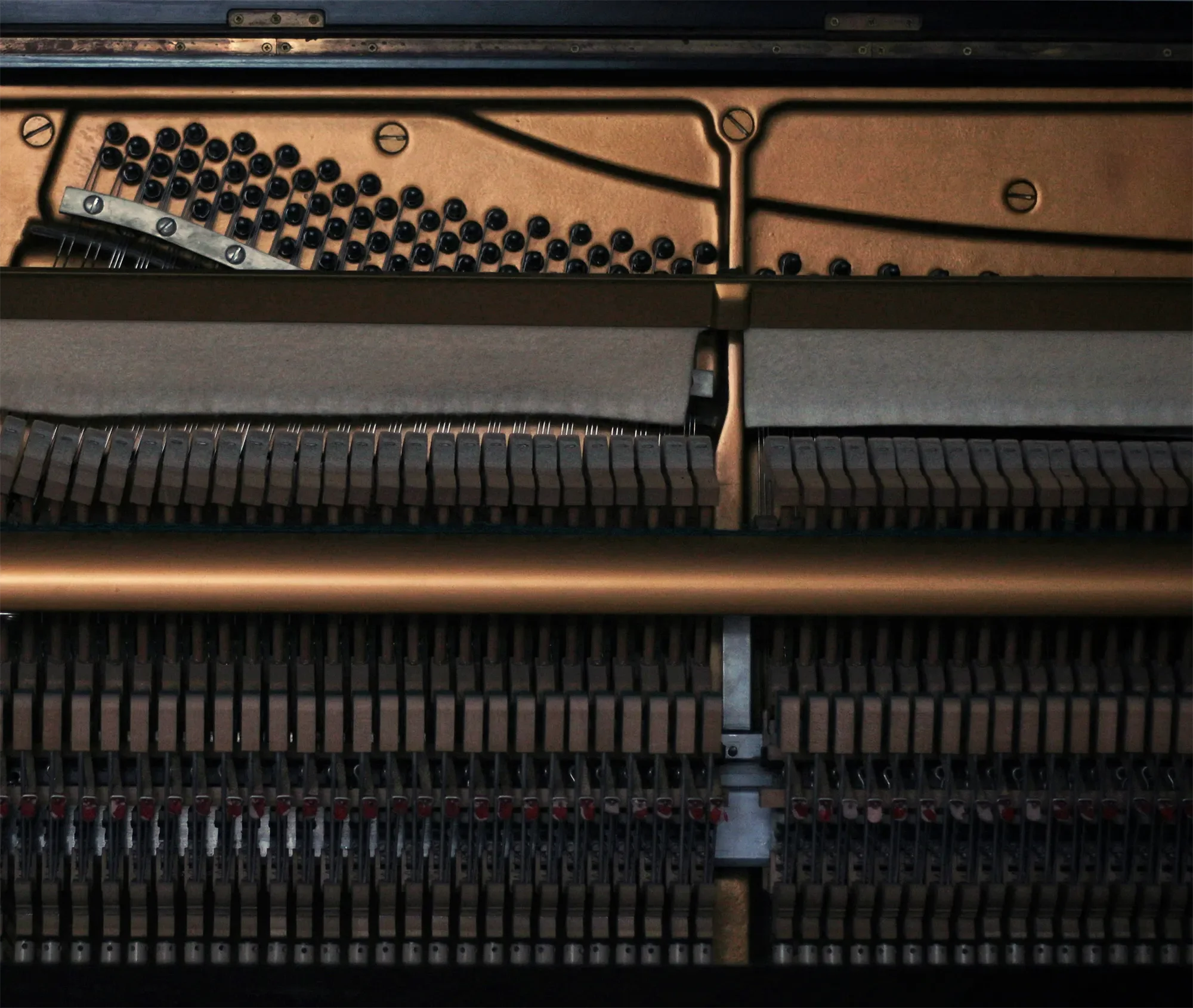
The piano is a marvel of human engineering. Over 10,000 individual parts make up the modern grand piano, made from a range of materials including wood, steel and iron, and felts, cloth, leathers, glues, and plastics.
The main event of the piano so to speak is the piano’s action. Specifically the ‘double escapement’ mechanism, invented by the French piano maker Sebastian Erard in the early nineteenth century, is what allows the pianist to have such dynamic control of the sound it produces.
Over the course of some years and at the rate you play your instrument, the incredibly delicate arrangement that the piano action abides by falls out, resulting in a piano that starts to feel sluggish, loses precision in playing, and even affects the sound.
——————————————————————————
Piano regulation is the highly interconnected process in which the technician adjusts the relationships of the parts in the action, and ‘realigns’ the double escapement mechanism, ensuring that the piano plays correctly.
A well-regulated piano allows for infinite gradations in volume and tonal textures, and in the hands of skilled pianist is a most wonderful experience, for the player and listeners alike.
-
Dust buildup is natural over time, just like any other item in your house that gets dirty. Superficial amounts of dust won’t harm your instrument, but a clean instrument is a sign of a healthy instrument.
If you’d like, you can very lightly dampen a soft cloth with water and dust your piano’s outer surface to remove fingerprints and light dust buildup. Be sure to immediately follow up with a dry cloth, as moisture and wood are a bad combination!
However, for deeper cleans, and certainly cleaning inside your piano, hire your technician to do it, as it is easy to damage parts, gouge or scratch your soundboard, and knock the tuning out if you clean near the tuning pins.
-
Owning a piano requires little upkeep, but not zero. It is imperative to have it tuned at least yearly. This benefits your instrument as a whole, gives positive tuning results, and should increase the life span of your strings, the cast-iron plate, and more. It also is good to allow your technician to get consistent eyes on your instrument, to be able to observe changes and be aware of its health over time.
Further upkeep, such as regulation and maintenance, is done on a longer timescale. Full regulation should occur perhaps every decade or so, depending on the rate you play your instrument.
Things like rebuilding, restringing, and other big projects are done on an as needed basis. A 100 year old piano may have been restrung once or twice, may have had its soundboard replaced or repaired, its hammers shaped once or twice, or perhaps replaced once.
Buying & Selling
-
You absolutely should have a potential piano inspected before purchase. Pianos can be deceptive. The notes may all play and make sound, but there is far more under the surface that you might not be aware of.
Many parts may be on their last legs. A technician will check that the tuning pins still hold torque, will inspect the action and assess its health, see if the soundboard has cracks which affect sound projection, and more.
In short, it is wise to be aware of anything wrong with your piano. You may purchase it now for a sum of money but be unaware it needs thousands of dollars in further repairs and rebuilding.
-
Aidan does provide appraisals to assist in purchasing or selling a piano, but he isn’t qualified to give certified monetary valuations.
An appraisal consists of a detailed and objective inspection of the health of the piano, to inform the state of its playing ability, to note potential repairs or rebuilding that is needed, and anything else that could help to make an informed purchase.
Scheduling
-
Born Piano Services’ main service area is the greater Sacramento area, as far west as Davis, south to Elk Grove, east to Placerville, and north to Rocklin.
-
To set up an appointment, you can always give us a call, or send a text to our number at
(916)778-7391
There are also “Schedule now” buttons that help you book an appointment online.